
Free, no login
How do you use a Kelly criterion calculator for sports betting? (2026)
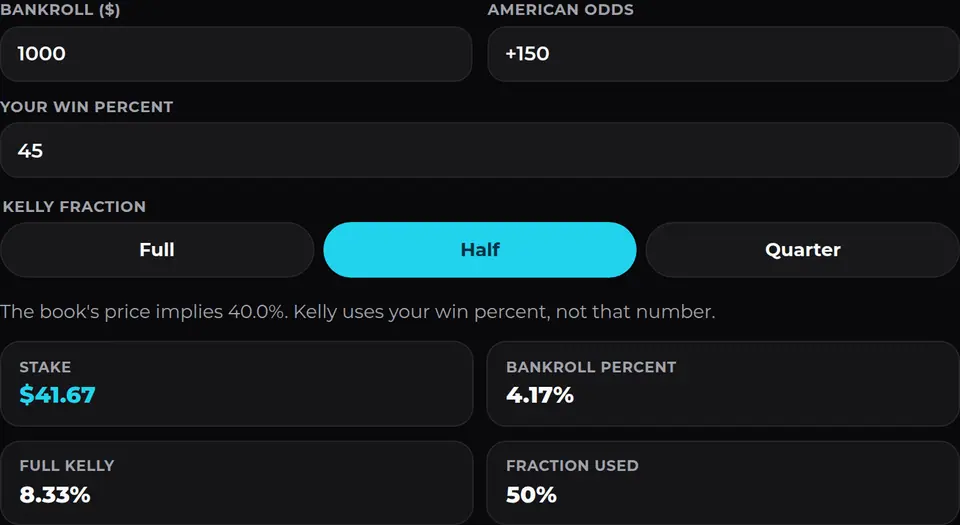
A Kelly criterion calculator turns your bankroll, an American price and your estimated win chance into a suggested stake. EdgeTilt shows full, half and quarter Kelly, plus the price-implied percent beside your estimate. At $1,000, +150 and 45%, half Kelly gives $41.67. That sizes a bet from your numbers; it doesn't find a winner or make a profit likely.
In short
- Enter your bankroll, American odds and estimated win percent.
- Full Kelly gives a stake fraction; half and quarter reduce it.
- A shrinking stake doesn't fix a shaky win estimate.
- No positive edge at your inputs? Kelly tells you to sit out.
What do you enter into a Kelly calculator?
Start with $1,000 set aside for betting. Add the price on the outcome you're looking at, such as +150 or -110. Type your own estimated win percent, say 45, and choose Full, Half or Quarter Kelly.
The calculator uses your estimated win chance, not the price-implied percent. At +150, the break-even number is 40%. If your own estimate is 45%, don't type 40 just because the book showed it. That distinction matters. The book's price includes its hold. It doesn't certify your estimate. If you only echo that break-even number, your inputs won't show an edge.
The public calculator runs in your browser, and nothing gets sent to EdgeTilt. No account needed. If your price is decimal or fractional, the odds converter turns it into American first.
How do you estimate the win percentage?
Kelly needs your estimate of how often this precise outcome wins. That can come from a model you trust or another carefully explained probability estimate. It can't come from the calculator. Sizing a bet and estimating a probability are separate jobs.
The no-vig calculator takes the hold out of a two-way American line using the proportional method. That gives a market-based fair probability, not a promise of truth. Use it as one input to your thinking, not a magic button that finds winners.
Write down why your estimate holds up before you calculate the stake. If you can't explain it, a precise-looking $41.67 in a results box shouldn't save it.
How does the Kelly formula work?
Kelly optimizes the expected logarithmic growth of wealth for a repeated independent bet under ideal assumptions. For this simple win-or-lose example, b is the net profit per 1 unit staked. At +150, b = 1.50. At -110, b = 100/110, about 0.909.
f* =bp - qb
Here, p is your estimated chance to win as a decimal, and q is the chance to lose, 1 - p. The page multiplies the resulting full Kelly fraction by your selected fraction, then by your bankroll. What you get is the stake, not the total return.
A +150 example, step by step
Try a $1,000 bankroll, +150 and a 45% estimated chance to win. The price implies 40%, so your input is five percentage points higher.
- Full Kelly: 8.33% of bankroll.
- Half: $41.67 stake, 4.17% of bankroll.
- Quarter: $20.83 stake, 2.08% of bankroll.
A second example uses a $5,000 bankroll, -110, 55% and quarter Kelly. The implied chance is 52.4%. Full Kelly is 5.50%, so quarter is 1.375%, displayed as 1.38% after rounding. Multiplied by $5,000, the stake is $68.75. The dollar figure uses the unrounded percentage.
These are math illustrations, not winning bets or expected earnings.
Why choose half or quarter Kelly?
A fractional setting multiplies the full Kelly stake, not your win chance. Half uses 0.5 and quarter uses 0.25. Same inputs, lower fraction, less of the bankroll on that bet.
- Full Kelly: at the +150 example, $83.33.
- Half Kelly: $41.67.
- Quarter Kelly: $20.83.
Full Kelly is extremely sensitive to an overestimated edge. Even an accurate estimate can lead to ugly drawdowns at full Kelly. A smaller fraction cuts that exposure, but it doesn't make a bad probability estimate good or a positive bet sure to win. And it doesn't settle whether Kelly fits your goals or how much losing you can take.
What does a negative Kelly mean?
There's no positive stake for that outcome at your price and estimated win percent. At -110 with a 30% estimate, EdgeTilt shows: "No edge at that win percent. Kelly says sit this one out." The stake rows stay hidden.
That's a pass, not a clue to bump your estimate until you like the answer. And it isn't automatically a reason to bet the other side. A negative result belongs to the exact inputs you gave it.
Kelly also doesn't run your whole betting day. Simultaneous bets can overlap or depend on one another. Stacking stakes that look independent can expose more of your bankroll than you meant to. This basic two-outcome page has no separate field for pushes, refunds, exchange commission, partial payouts or multiple outcomes. Don't force those wagers into this formula and assume the answer still fits.
How is Kelly different from expected value?
Expected value estimates what a bet returns on average using your price and probability assumptions. Kelly sizes a stake to optimize the average logarithmic growth of your bankroll under its model's assumptions. Put simply: EV asks about average value. Kelly asks about the stake. A bet can be positive EV and still lose, and fractional staking can't change that.
If you have a defensible estimate and an affordable bankroll, use the calculator to see the stake. If you can't justify the win percent, you're just using the offered line's own break-even chance, or you're looking at a wager outside the simple win-or-lose case, stop there.
Keep going
- No-vig calculator: compare both sides of a two-way price.
- Odds converter: turn a decimal or fractional price into American.
- Sports Bet Tracker: record a wager separately; this public calculator doesn't import or save bets.
Not betting or financial advice. For entertainment and information only. You must be 21+ to gamble. If gambling stops being fun, call 1-800-GAMBLER.
FAQ
Why is my win percent different from the implied percent?
The price-implied percent is the break-even chance at that price, with the book's hold included. Kelly uses your own estimated chance to win, which may take the hold into account when you estimate it from a two-way market.
Should I use full, half or quarter Kelly?
The page can calculate any of them, but the right choice depends on how shaky your estimate is and the losses you can take. Half and quarter use 0.5 and 0.25 of the full Kelly stake, not half or quarter of your win probability. No fraction guarantees safety.
What if there is no edge at my inputs?
The page hides the stake rows and says Kelly says sit this one out. That applies to the exact probability and American price you entered. It isn't a green light to bet the other side.
Is the result a dollar stake or potential payout?
It's the suggested dollar stake. The page separately shows bankroll percent, full Kelly and the fraction used. Those figures don't fold winnings into the stake.
Does this handle pushes, refunds or exchange commission?
No separate fields are provided for those situations. The basic formula shown models simple two-outcome win-or-lose bets. Don't assume it covers pushes, partial payouts or commission-adjusted exchange math.